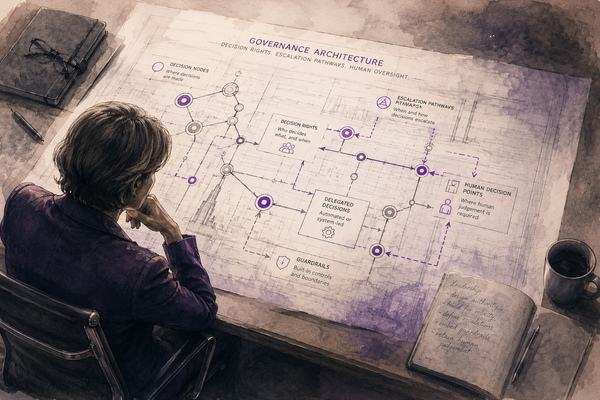
Governance Isn't a Meeting Anymore
Governance as a meeting is a norm worth rewriting. Governance as architecture is what replaces it.
A collection of ideas on leadership, credibility, transformation, AI, and the future of work, written for leaders, high performers, and those who aspire to carry greater responsibility.
Authenticity and capability - combined, visible, and legible to the people who matter - outperforms performance every time. Not performance as in results. Performance as in the managed version of yourself you put on for rooms that make you feel like you have to earn your place in them.
Read the article →
Governance as a meeting is a norm worth rewriting. Governance as architecture is what replaces it.
Disagreement handled well is a credibility accelerant. Disagreement handled poorly is a credibility tax. The issue is not whether to disagree, it's how to frame it as analysis rather than noise.
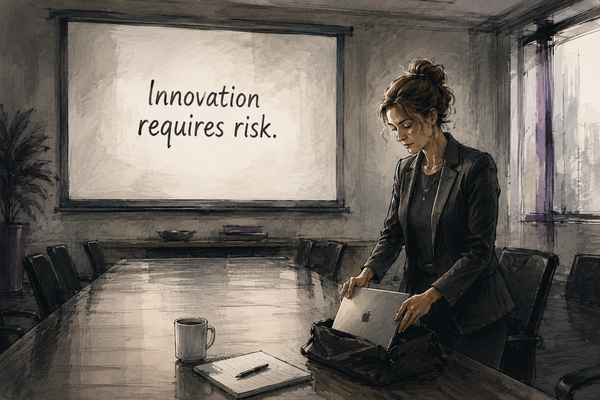
For years I've told leaders to embrace failure as the cost of building anything new. Then a few people asked if I'd really give up a steady income to go out on my own, and I caught myself holding my own risk to a harder standard than theirs.
Attribution is not automatic. It is built from a record, and records require entries made before the final moment, not reconstructed from it.
People don't resist change, they resist ambiguity: not knowing if they'll still belong, still matter. Change management handles the mechanics. Leadership creates clarity from uncertainty, and gives people real agency in how they move through it.

No amount of calibration will close a gap that exists in the evaluation system itself. The answer isn't a more refined adjustment. It's a different theory of how credibility forms.
Credibility isn't only built in conditions that reward it. It's defined in conditions that test it.
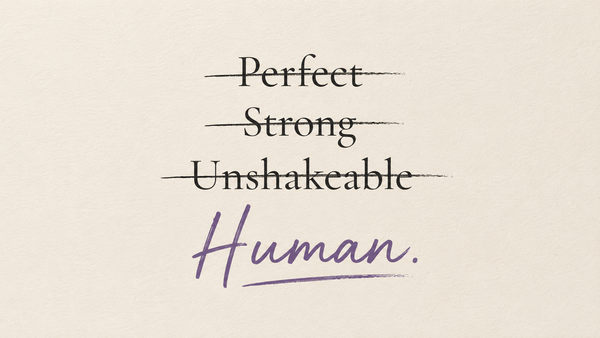
We expect leaders to look composed on their worst days. That standard is a norm worth rewriting. Leadership isn't measured by avoiding stumbles, but by recovering from them, giving yourself the grace you offer everyone else, and standing back up.
The credibility account opens at the first interaction. After that, interest compounds in whichever direction the first deposit set.
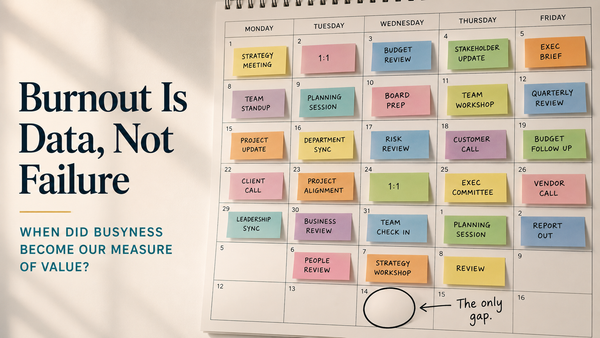
Most leaders treat burnout as a personal failing to push through. It's not. It's information: a signal your role has outgrown what one person can sustain. The skill isn't pushing harder. It's paying attention before you have no choice but to stop.