Trust the process. Trust the people more
what happens when structure is sound but nobody inside it is actually being trusted to use their judgement, and what that costs organisations that are leaning harder into process as complexity increases.
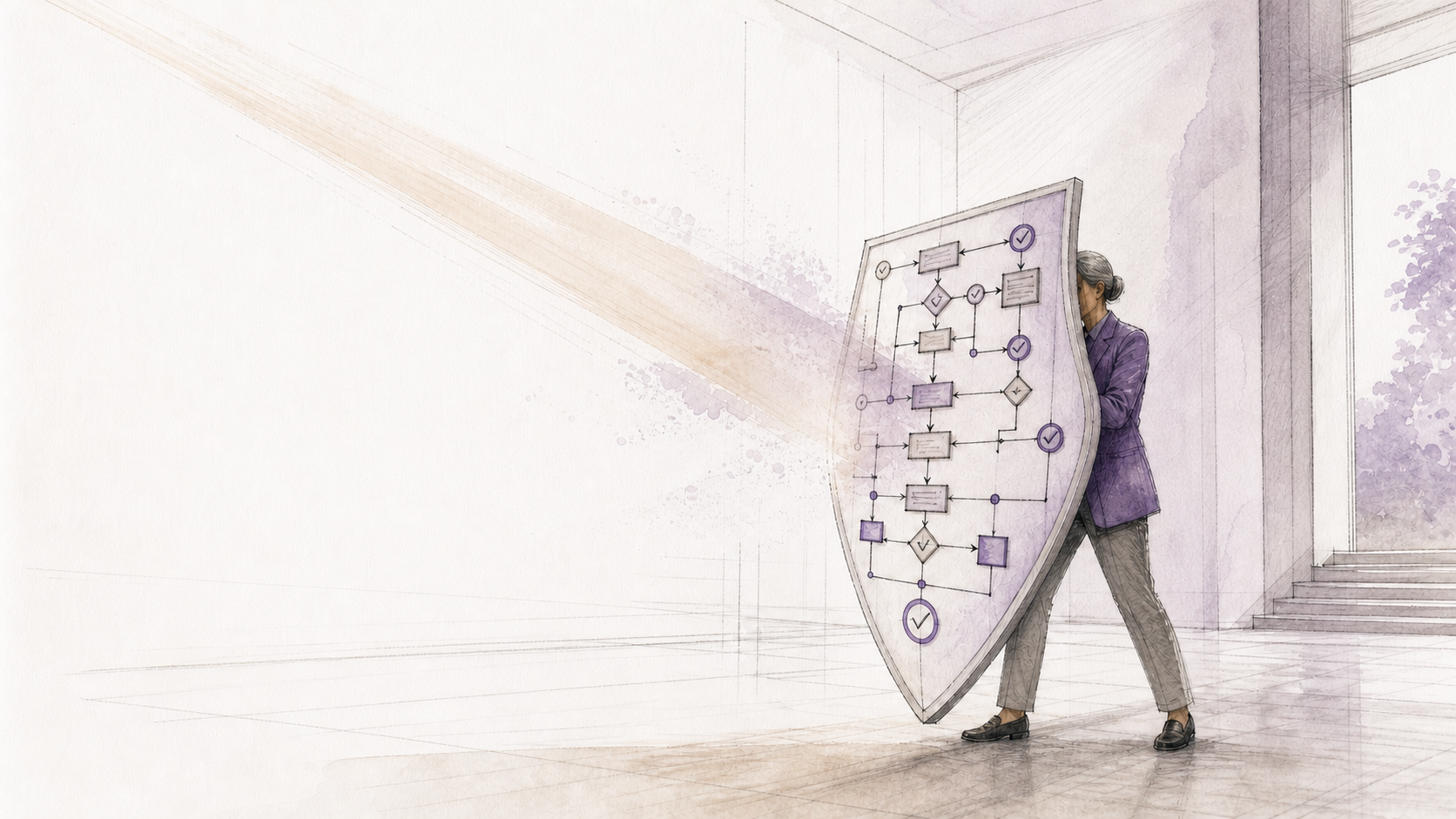
I was once in a leadership meeting where a senior leader said, in response to a direct question about why a decision had gone the way it had, that the process had been followed. They were asked again, differently. The answer came back the same. The process had been followed. At the third attempt I understood that the process wasn't an explanation. It was a shield.
That exchange has stayed with me because it's not rare. It's the default. Somewhere along the way, "trust the process" stopped being a statement about mechanism and became a statement about avoidance.
Organisations have built extraordinary infrastructure around process. Stage-gates, escalation paths, governance checkpoints, review cycles. Most of it exists for good reason. A well-designed process lets a leader extend trust further than personal verification ever could. It's how you scale judgement across people you can't watch every day, in decisions you can't personally review. That's the whole point of it. Process, done well, is trust made scalable.
But somewhere in most organisations, that relationship inverts. The process stops being the thing that carries trust in people and becomes the thing that replaces it. You can tell the moment it's happened, because the process starts getting cited the way that leader cited it: not as an account of what was decided and why, but as a way of not answering that question at all.
The tell is simple, and it shows up in exactly one place: what happens when the process and the person's judgement disagree. If the process wins by default, every time, regardless of who's exercising judgement or how well they've earned the right to exercise it, then the process was never really about trust, it was about control.
This is the interpersonal edge of a structural problem. Good governance is architecture. It's the operating model that determines how decisions move through an organisation, who holds authority at each point, and how accountability is distributed. But architecture without trust in the people occupying it doesn't produce good governance. It produces bureaucracy that has learned to describe itself as discipline. The structure can be sound and still be hollow, if nobody inside it is actually being trusted to use their judgement within it.
I've watched leaders build excellent processes and still run organisations where nobody trusts anybody. The process was never the problem. It was doing exactly what it was designed to do. What was missing sat underneath it: a willingness to let the people running the process truly exercise judgement inside it, including the judgement to depart from it when the situation called for that. That departure cannot be private or consequence-free. The greater the discretion a leader exercises, the greater their obligation to explain the judgement behind it, make the trade-offs visible, and remain accountable for the outcome. Trust is not freedom from scrutiny. It is the willingness to exercise judgement transparently and stand behind it.
This matters more, not less, as organisations lean harder into process as a response to complexity. The instinct makes sense. More moving parts, more risk, more need for hard lines. But the answer to complexity was never meant to be less trust in the humans navigating it. It was meant to be a structure that lets that trust extend further. When process becomes the destination instead of the delivery mechanism, organisations end up with leaders who are excellent at following steps and increasingly unpractised at the judgement those steps were supposed to protect.
The fix isn't fewer processes, and it isn't rejecting structure in favour of unstructured trust either. That's its own kind of failure. The fix is remembering what the process was for in the first place, and checking your own organisation against that standard honestly. Ask what happens in your business when someone's judgement and the process point in different directions. If the answer is that the process always wins, you don't have a trust problem hiding behind good governance. You have a control problem wearing governance as a disguise.
Process should be the thing that lets you trust people faster. The moment it becomes the thing you reach for instead of trusting them at all, it has stopped doing its job, no matter how well it's been designed.
— Cindy Schwartz
Founder, Executive Excellence Group | Rewriting Leadership Norms