Governance Isn't a Meeting Anymore
Governance as a meeting is a norm worth rewriting. Governance as architecture is what replaces it.
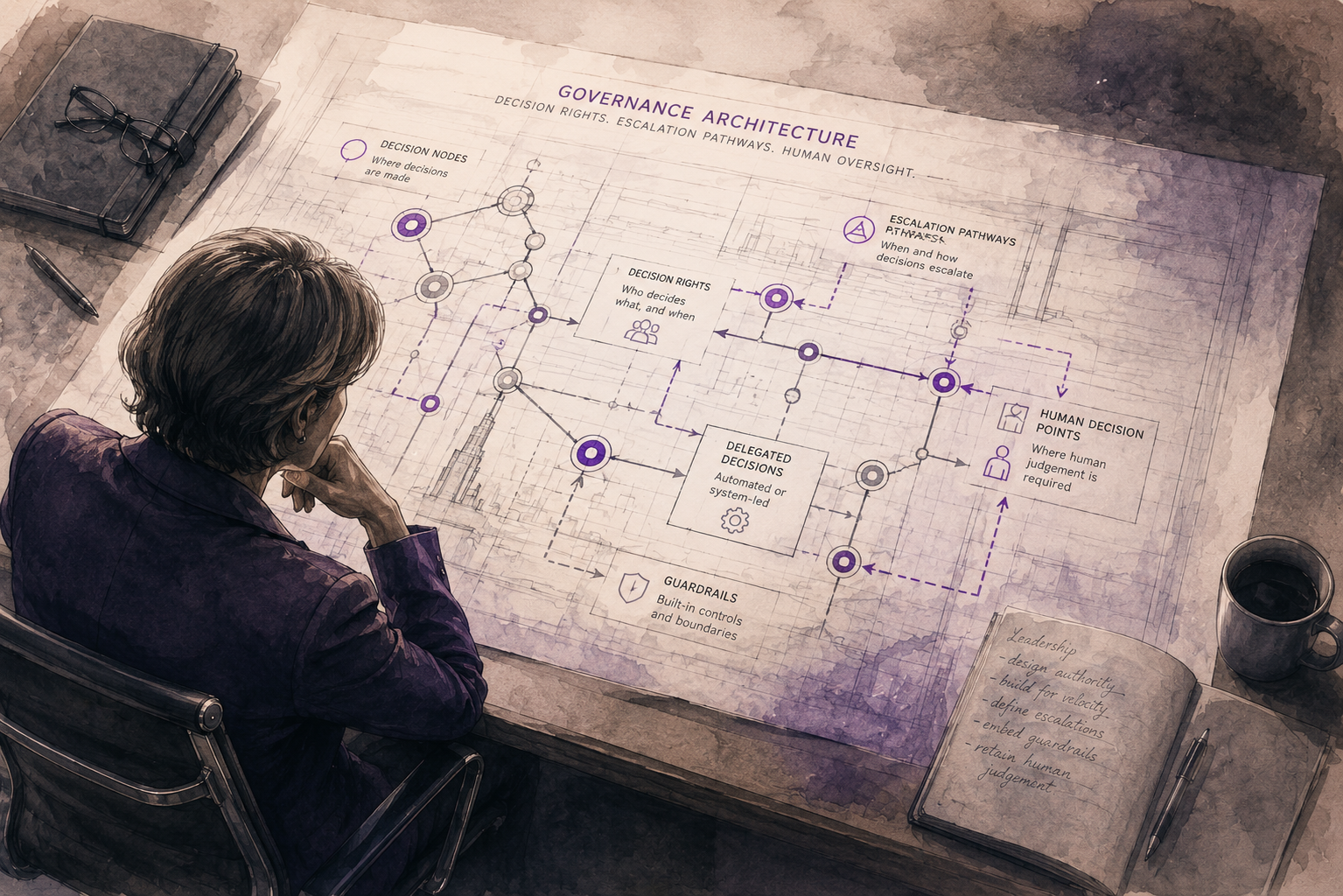
A proposal lands on the agenda. A committee reads it. Questions get asked, risks get noted, someone signs off, and the work begins. Anyone who has sat in that room knows the rhythm. It is how most organisations have made important decisions for decades, and until recently, it worked well enough. It assumed the important decision was the one made before deployment. Approve the system, then monitor it. Review, release, revisit next quarter.
That assumption held when systems did roughly what they were told, at a pace people could follow. AI has quietly broken it, and few organisations have noticed the break.
Most of the AI conversation happening in executive teams right now is about the wrong ledger. Data quality, integration effort, infrastructure, licensing, token spend. Those costs are real, but they are not what determines whether an AI initiative actually succeeds or fails inside an organisation.
The larger cost sits underneath all of it, in the governance model itself. Most approval frameworks were built for decisions that happen at the pace of meetings. AI does not wait for meetings. It keeps deciding, continuously, long after the committee has closed its folder and moved to the next agenda item.
Picture the more common failure mode when something goes wrong. The instinct is to convene a review, gather the right people, work through what happened. Sensible, on the surface. But by the time that group is in the room, the system has already made thousands more decisions without anyone watching. That is not a delay in oversight. It is a period where governance existed on paper and nowhere else.
The usual fix makes things worse, it adds more approvals, more reporting, more checkpoints. Essentially more time. It feels like diligence. It is actually a compliance response to what is fundamentally an architecture problem, and no amount of additional sign-off will fix a structure that was never designed to keep pace with continuous decisions.
Real governance, in this environment, cannot depend on people gathering around a table every few weeks to decide what happens next. Decision rights need to live inside the operating model itself, not in a calendar invite. Escalation paths need to be built before they are needed, not improvised after something breaks. Leaders need to be explicit, in advance, about which decisions stay human, which can be delegated, and at what point authority automatically returns to a person. Most executive teams have never had to design this deliberately. Authority was simply assumed to sit with whoever was senior enough to be in the room.
Governance as a meeting is a norm worth rewriting. Governance as architecture is what replaces it.
For years, leadership capability was judged by the quality of decisions executives made themselves. That is starting to change. Increasingly, capability will be judged by how well leaders design systems that keep making sound decisions when they are not in the room to make them. That is a different skill from good judgement under pressure. It is the skill of building judgement into structure.
Most organisations have spent heavily on AI capability this year. Very few have spent anything on leadership capability for an environment where decisions happen continuously rather than periodically. That gap will not close on its own, and it will not be closed by a bigger budget line.
Increasing the AI budget is the easy decision. Admitting the governance sitting underneath it was designed for a different decade is the hard one. The organisations that come out ahead will not necessarily be the ones that deployed AI first. They will be the ones that redesigned authority before the technology outpaced it.
— Cindy Schwartz
Founder, Executive Excellence Group | Rewriting Leadership Norms