Take it out of the shadows
It’s October, which means it’s Breast Cancer Awareness Month. This is the first of four Rewriting Leadership Norms pieces bringing that awareness into the leadership conversation.
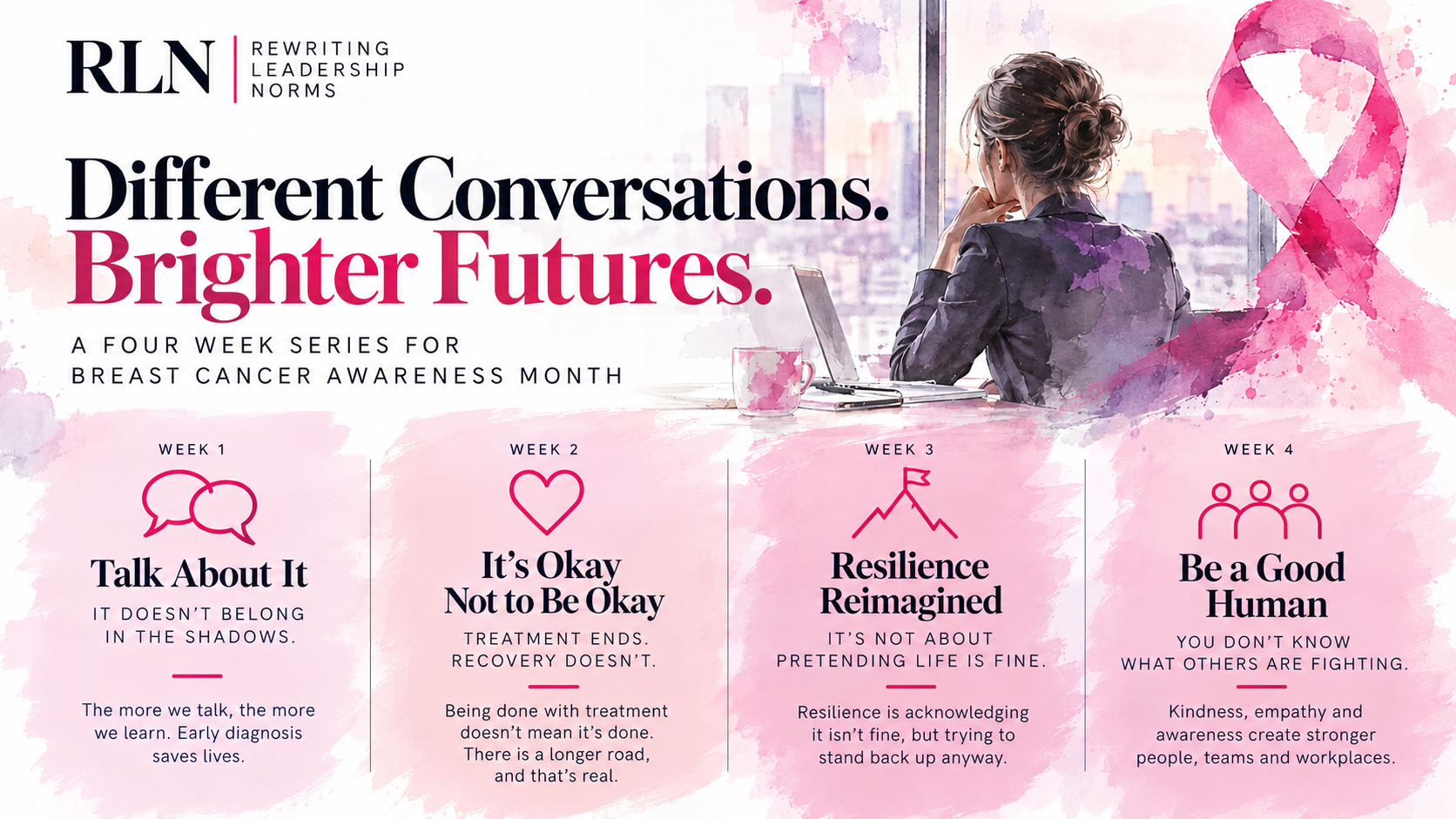
It’s October, which means it’s Breast Cancer Awareness Month. This is the first of four Rewriting Leadership Norms pieces bringing that awareness into the leadership conversation.
As many of you know, I went through my own breast cancer journey a year after my wife went through hers. This one is very personal to me. Since I was diagnosed, I can name 14 women I personally know who have also been diagnosed. Sadly, that number keeps going up.
I made a deliberate choice about how I would manage my diagnosis and the 18 months of treatment that followed. For me, it meant being far more public than I was entirely comfortable with. I stepped outside my comfort zone because too many people go through cancer in the shadows.
There are many reasons for that. Cancer is deeply personal. Breast cancer involves parts of our bodies most of us would really prefer our colleagues never have to think about. There are appointments, surgeries, scars, hair loss, exhaustion, fear, and conversations you never imagined having at work.
Keeping all of that private can also create another burden. You are already carrying the diagnosis and the treatment. It isn’t fair that you have to add the additional load of making sure nobody can see it.
I chose to keep working through much of my treatment, and I chose to be open about what was happening. I showed up on video calls wearing more baseball caps than I had worn to work in my entire career. There were days when I looked different, felt different, and had considerably less energy than I was used to having. I decided I was still going to show up as myself.
Work gave me somewhere to put my attention other than being a patient. My leadership gave me the space to do that. They allowed me to keep contributing without pretending that nothing had changed, and that helped me through the hardest period of my life.
I am not suggesting that everyone should talk publicly about their cancer. Nobody owes their workplace their diagnosis, their medical history, or an explanation of what is happening to their body. Privacy should always remain a choice. But silence should be a choice too.
Serious illness still sits strangely in many workplaces. We lower our voices. We avoid asking questions because we are frightened of saying the wrong thing. We wait for the person who is sick to make everybody else comfortable enough to acknowledge what is happening.
Breast cancer does not belong in the shadows simply because talking about it makes us uncomfortable. The more openly we can talk about it, the more people hear the stories. The more they recognise the symptoms and risks. The more likely they are to go for a scan, make an appointment, ask a question, or encourage someone they love to do the same. Early diagnosis saves lives.
To me, that was a good enough reason to get a little uncomfortable. It is also where the norm worth rewriting comes in. We have built a version of professionalism that often asks people to make the difficult parts of their lives invisible. Illness can be acknowledged privately, managed quietly, and accommodated discreetly, but once it becomes visible, people can start to feel exposed in ways they never asked for.
I would like us to rewrite that. A workplace where someone can keep working through treatment if that is what helps them, without hiding off camera, disappearing for six weeks, or waiting until they look a little more like themselves before they are allowed to be visible again. And a workplace where someone can step away completely if that is what they need. The choice belongs to the person, and the workplace's job is to make either one safe, so that nobody feels they have to protect everyone else from what they are going through.
If talking about breast cancer a little more openly means one person notices something earlier, books the scan they have been putting off, or encourages someone they love to get checked, then I am very comfortable making the conversation a little less comfortable.
— Cindy Schwartz
Founder, Executive Excellence Group | Rewriting Leadership Norms