Burnout Is Data, Not Failure
Most leaders treat burnout as a personal failing to push through. It's not. It's information: a signal your role has outgrown what one person can sustain. The skill isn't pushing harder. It's paying attention before you have no choice but to stop.
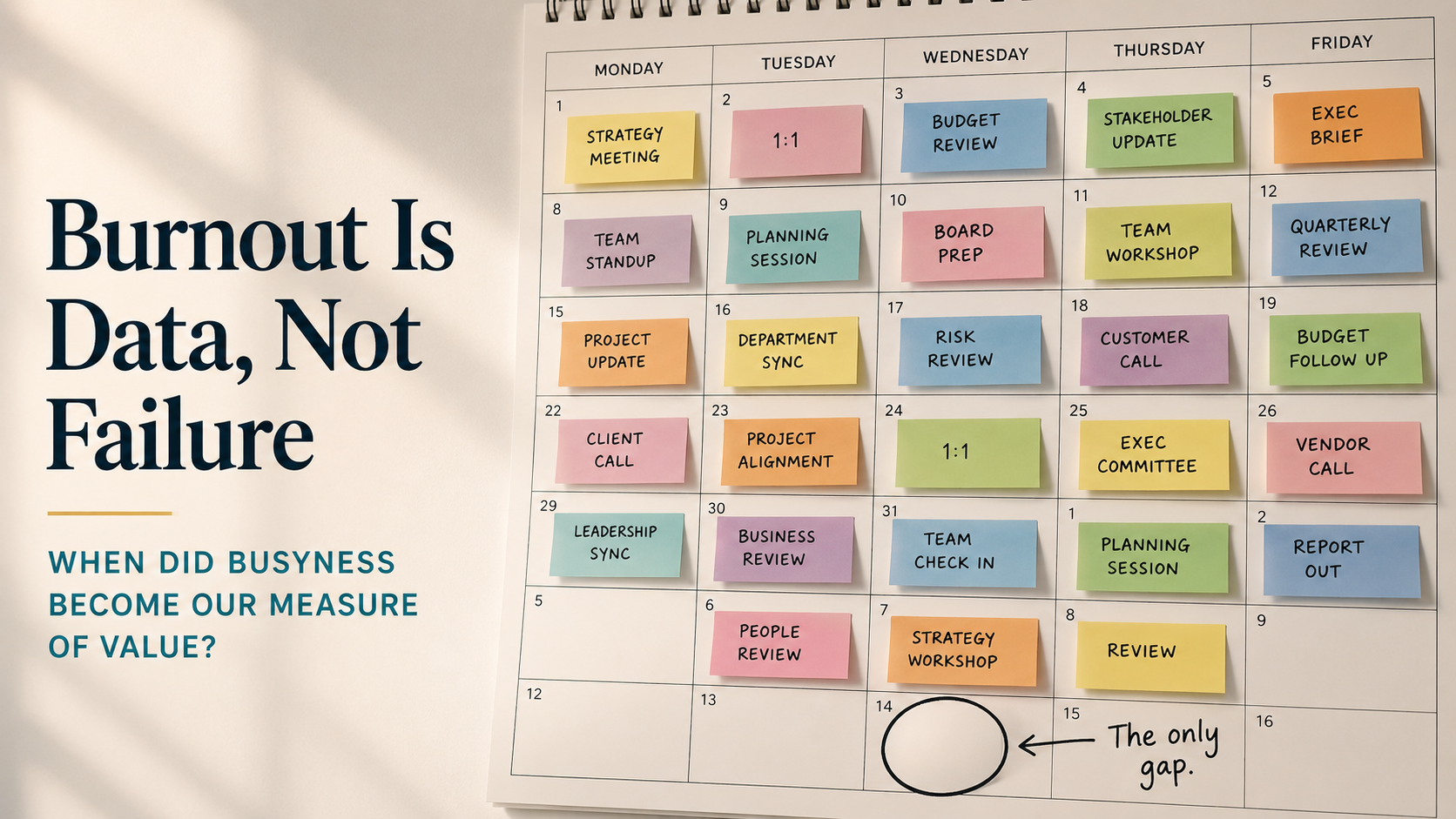
Most leaders treat burnout as a personal failing. Something to push through. Something to manage better. Something that means they need to be tougher, more resilient, or more disciplined. I think we have the conversation backwards. Burnout is not usually the problem. It is information. The problem is what the burnout is trying to tell you.
For years, I treated exhaustion like a performance issue. If I was tired, I worked harder. If I was overwhelmed, I became more organised. If I felt stretched, I convinced myself that was simply the price of leadership. Like many high performers, I assumed the answer was to become better at carrying the load. What I eventually learned is that carrying more hides the problem, it doesn’t solve it.
Most leaders do not burn out because they are weak. They burn out because they have been ignoring signals for too long. The signal might be that your role has expanded beyond what one person can realistically sustain. It might be that your boundaries exist intellectually but not behaviourally. It might be that you are spending every day solving problems that should belong to somebody else. It might be that you have become so valuable operationally that nobody notices you are drowning. Or it might simply be that the way you are working no longer matches the life you are trying to build.
The mistake is treating the exhaustion as the thing to fix. Imagine your fuel light comes on in your car. You would not put tape over the dashboard and congratulate yourself for solving the problem. Yet high achievers do the equivalent all the time. We become more efficient. We optimise our calendar. We squeeze another hour out of the day. We find better productivity systems. Sometimes those things help. Often they simply help us ignore the signal for longer.
Part of the challenge is that many leadership environments quietly reward the behaviours that create burnout. Busyness gets mistaken for importance. A full calendar becomes evidence that you are in demand. Constant responsiveness gets interpreted as commitment. The more meetings you attend, the more problems you solve, and the more people rely on you, the more valuable you appear. At least on the surface.
The problem is that busyness and relevance are not the same thing. Some of the most influential leaders I know look surprisingly calm from the outside. They are not important because they are involved in everything. They are important because they are focused on the things that matter most. Somewhere along the way, many of us learned to measure our value by how much we carry. Leadership maturity is recognising that your value is not determined by the volume of work flowing through you. It is determined by the outcomes you create, the decisions you enable, and the capability you build in others.
What if burnout is not asking you to push harder? What if it is asking you to pay attention?
The strongest leaders I know eventually stop seeing recovery as a reward they earn after the work is finished. They start seeing it as part of the system that allows the work to happen in the first place. That shift matters because recovery fuels performance, it doesn’t hinder it. Boundaries are not a sign that you care less. They are often evidence that you intend to keep showing up for the long term. Resetting is recognising that sustainability is a leadership decision, not a personality trait.
The challenge is that many of us wait until the signal becomes impossible to ignore. We wait until the exhaustion becomes physical. Until the motivation disappears. Until the frustration starts leaking into conversations, decisions, and relationships. By then, the data has been sitting in front of us for months, sometimes years.
Burnout is not a badge of honour. It is not proof that the work matters. The leadership norm worth rewriting is treating it that way. We need to treat it as information about a system that is no longer functioning the way it should. The question is not whether you can push through it. Most leaders can. The question is whether you are paying attention to what it is trying to teach you before you have no choice but to stop.
Most leaders are remarkably good at pushing through. The real leadership skill is recognising when pushing through is no longer the answer. That's the rewrite.
— Cindy Schwartz
Founder, Executive Excellence Group | Rewriting Leadership Norms